Monday, October 6, 2008

The Curps

The first Curp in America (as far as we know) was Frederick, born in 1771. Some people think Frederick came to this country from Germany. I suppose that is a reasonable assumption—Curp does sound like a good German name. However, I haven’t been able to find any proof of this claim. Frederick was ordained as a deacon in the Methodist Episcopal Church in 1795. We find him working with the church in the small rural Ohio community of Hillsborough and the surrounding area. Apparently, he served more than one congregation because he is referred to as a “circuit rider”. Land for a small cemetery was donated by Frederick and his wife Abigail to the Methodist Meeting House in Carmel, Ohio. Frederick and Abigail’s children as well as the next generation were born in Highland County, Ohio. Since Frederick, Abigail, and most of their children are buried in the Curp Cemetery, I assume the family liked the area and its people and served the community well for their entire lives.
Originally a Methodist church, now a community building.

Currently, the Church of God
At some point between 1795 when Frederick was ordained in the Methodist Episcopal Church and the end of the century the family changed denominations. Gene’s grandfather, Mahlon Obert Curp (the fourth generation from Frederick) was a circuit preacher for the Primitive Baptist Church. His circuit included the Pataskala area which is in Licking County. Mahlon was born in Fayette County, Ohio, just the next county north of Highland and married Cora Dennewitz (now that’s a good German name) of Chillicothe. Cora and Mahlon’s children were born in Licking County, so they must have moved there soon after marrying. That is how Gene’s father happened to be born in Licking County. Mahlon along with most of his children are buried in Wilson Cemetery in Newark. Like their ancestors before them, they were well established in the community for a lifetime.

Gene’s father, Charles, worked for Owens Glass in Newark until 1958 when he moved to Nashville to take a job at Ferro Fiberglass. Gene, like the rest of the family, was born in Licking County, but moved to Nashville at the age of 8 and never left. You set those Curps down some place and they don’t ever leave. I suppose you should be careful about inviting them over for dinner.
Location of the Curp Cemetery
Today, our journey took us to Highland County in search for the Curp Cemetery. From a Google Map we thought we knew exactly where to go. After stopping at 2 old churches in the tiny community of Carmel in the hope that one of them might be the meeting house where Frederick had preached, we set out to find the cemetery. We drove back and forth several times swiveling our necks back and forth trying to find tombstones. We were looking, not for something as large as Frazeysburg, but at least on the lines of what we found at Broomstick. We saw nothing. Up and down again to no avail. We took a lunch break at the Rocky Fork Truck Stop and asked several older gentlemen there if they knew anything about an old cemetery. We got a lead from one old man. He tried to describe where he thought the cemetery was and if we didn’t find it there, he gave us a person to ask. Back down the road again to where he suggested and nothing. So Gene knocked on the door of the 3rd house on the left. Mrs. Betty, “who has lived in the area forever”, pointed right to the cemetery. Well, she actually pointed right to a clump of trees and underbrush. We had driven by so many times and never seen it. I had to get out of the truck and walk right into the trees before I could see what was left of the Curp Cemetery. Long neglected, the few stones that are left were push over and damaged to the point of being illegible. Gene took a stick and literally stirred the leaves and brush around to uncover stones. We were unable to find the one we were most interest in—Frederick Curp, the family patriarch, but we did find two of his daughters and a grandson. Enough to know we were in the right place.
Searching for tombstones

Grandson of Frederick Curp
We were disappointed not to find what we wanted, but glad to have found something. Unless we stumble across more information in the next couple days that is about all we can do with the Curps. Gene’s grandfather, Mahlon Obert, married a lady from Chillicothe named Cora Dennewitz. She is not buried with Mahlon at Wilson Cemetery in Newark. She has some relatives buried in Chillicothe. If we can find that cemetery, perhaps we can find here grave as well. If not, we are going to give Gene’s ancestors a rest for a while and turn our attention to the Lancasters and Harpers, my mother’s people.

We’ll see what tomorrow brings.

Sunday, October 5, 2008

Zanesville, Ohio

We moved and are now settled in Zanesville, Ohio, Gene’s old stomping ground. Actually, we are a few miles east of where he grew up but we had to be in a campground with good Verizon service for his work. But we are close. We had a great trip today. We left Waterford this morning in 38 degree cold and are now basking in the fall sunshine and big blue skies with 70 degrees showing on our thermometer. The traffic was very light all day and the roads were in excellent condition.
Edna on her graduation from High School, 1930.


Gene’s mother was an Ashcraft. This line of the Ashcrafts came from Berkeley County, West Virginia (on the east side of the state in the corner with Virginia, Maryland, and Pennsylvania) to settle in this area around the end of the 1700s by way of Fayette County, Pennsylvania which is just north of the West Virginia border. It has been rumored about for many, many years that the “hillbillies” from Kentucky and West Virginia came looking for jobs in the growing Ohio cities. The 1700s seem to be a bit early for that migration so we don’t really know why they came unless they were just following the trend of the time to “go west”. Daniel B was the first of our line of Ashcrafts to settle in Ohio, but his descendants have scattered beyond here to Indiana, Kentucky, Arizona, and even back to Pennsylvania.

Gene's mother, Edna, was one of 7 children. I didn’t know her until she was in her late 80s. She was a feisty, little lady and little she was. I am not very tall, but I towered over her by almost a full head. She was one of those people who saved everything. Anytime I went in her home, it was always nice and neat with everything in its place. After she passed away and I had the privilege of cleaning out the house, boy did I get a surprise. Every piece of paper that she ever came in contact with, she kept—every receipt, every calendar, and every letter. I don’t know how so much paper got in that little house. Edna also liked to hide money around. She told Gene one time that she had a little stash of money in the vacuum cleaner. I certainly didn’t want to send the vacuum to Good Will with the family fortune in the bag so I searched the vacuum cleaner and every thing else I thought she may have thought a good hiding place. I never did find any money, but you can imagine my surprise when I lifted up the cushions of the living room sofa and found about 200 greeting cards which Edna had received over the 93 years of her life. I guess she had run out of room in all the closets and drawers. You may think we should have noticed something under the sofa cushions, but we didn’t sit on that sofa often because it was for “special occasions”. Edna had set up the living room in 1958 and it was exactly the same in 2005 except that everything had faded and the foam in the sofa cushions had turned to stone. She was a keeper, all right. Edna, Edna, how I wish I had known her better.

I'm wondering who these fine ladies are.
The photo was taken about 1913.
Edna was actually very good at record keeping. She wrote who, what, and where on just about everything. Thankfully, she did that for thousands of photographs. But I still have a few, maybe 50, that are not labeled. Some of the subjects in the photos are so interesting I just have to know who they are. This week we are on a quest to find out.

Saturday, October 4, 2008

Finding Ourselves

As a child I spent a great deal of time at my grandparent’s house, that’d be my mother’s parents, down at Brier Pond in Hickman County, TN. My granddaddy had a farm with tractors, and mules, and wagons, and pigs, and a creek to swim in, a hay loft to play in, and old trunks with old clothes for dress up. My imagination could just run wild and it did. My mother would probably say I ran wild and I probably did.

Today, about the only thing left of the old farm place is the land and the creek. Now my imagination wants to know where my grandparents come from and why did they settle on Brier Pond, Hickman County, middle Tennessee.

My grandmother was forever telling me stories. She told me she was part Indian. She told me she knew Jesse James of outlaw fame. Now, I want to know how she knew Jesse James and what tribe her ancestors belonged to.

Each of us has a history and it is that history that makes us where and what we are today. I’m on a quest to find out all I can about the names in our family Bibles—Curp, Ashcraft, Lancaster, and Harper. This may really take the rest of my life, but I am going to make it a priority for the next 2 months.

We’ll start with the Ashcrafts in Newark, Licking County, Ohio. We’re headed there tomorrow.

A Journey Back In Time

This is the time of year when we want to be back with friends and family, to enjoy the holidays together, and to catch up on what everybody else has been doing this summer. We have doctor and dental appointments and we want to be home to vote in this important election. We need some time to relax and rejuvenate these road-weary bodies. Besides, it is cold here—38 degrees when we got up this morning and the weatherman said it felt like 34. So we are headed south to Nashville.

Our first stop will be near Columbus, Ohio where Gene spent a few childhood years. He still has family members in the area we want to visit. Our next stop as we head south will be somewhere near Cincinnati where Gene’s father’s people were from. Last stop—Nashville where we will be until the end of the year.

Over the past several years I have poked around in my family history, primarily my mother’s people, the Lancasters and Harpers. While going through my mother-in-laws things after she passed away, I found some genealogy stuff which piqued my interest in Gene’s family histories, the Curps, Ashcrafts, and Reids. Also among my mother-in-laws things were several unidentified photos. As time passes, so do the people and the memories that can help us fill in the gaps in our family trees. So this journey home for the holidays is also a journey back in time to explore our pasts.

This will not be a travel journal like the others I have done, but it will be the story of where our families came from and how and why they came to this part of the country. I’ll share the family stories that I feel would be of interest, and for those of you who know my family you know that can be a real trip in itself. I think it will be fun and I am looking forward to it. I hope you will stay with us and enjoy the journey.

Friday, October 3, 2008

The End of Route 6

We have come to the end of our exploration of US Route 6 across Pennsylvania. As is our custom when we come to the end of a trip, we like to look back with an analytical eye and answer a few questions. What was our favorite part? What did we like the least? What would we do differently or how could we have made it better? So for those interested in this same trip or those who are just curious, here are the answers to these questions.

Route 6 is right at 400 miles across the northern tier of Pennsylvania, primarily a 2 lane road passing through rural farm land, several small towns and villages. It also crosses the Pocono and Alleghany mountains. We enjoy the farmland. My favorite time to view farmland is in the spring when row crops are just beginning to pop out of the ground, when the soil still looks freshly tilled and the individual rows are visible. During our drive through rural Pennsylvania, the crops, mostly corn, had already done their thing and the fields were full of dry stalks. However, the rolling landscape was quite picturesque, especially around Wellsboro. In the mountain areas the fall foliage was near its peak, filling the countryside with color. On the eastern and western sides of the state where we were not at as high an elevation, the leaves had not yet turned making the drive much more mundane. If we had started one week later, we may have picked up more color on either end, but the mountains may have been past their prime. We enjoyed the small town feel of each of the communities along the way with Wellsboro being our favorite. But, at heart, we are nature lovers and quickly reached our limits on shops and sidewalks. We do enjoy the architecture of early America, but since the entire state was settled about the same, the towns began to look the same. Since we have such an interest in nature and being outdoors, naturally our favorite areas on this trip were The Grand Canyon of Pennsylvania and Presque Isle State Park. We would have been happy to stay longer at both of these places.

Our least favorite and most stressful part of the trip was towing the Montana on Route 6. The road is just too narrow and congested in all of the small towns for us to be comfortable. We avoided towing on route 6 as much as possible and opted for the interstate instead. We only actually towed about 100 miles of the 400 mile length. Because of that, we darted up and down in either direction from where we were camped in order to visit the recommended areas. We spent a lot of time in the truck and that diminished our enjoyment of the trip overall. We probably could have eliminated some of the stress and made the whole trip much more enjoyable if we had extended our time in each area. Then we wouldn’t have felt like we were rushing to see all there was to see. Since we were in a bit of a hurry to do this trip, we skipped much of the section from Wellsboro west for about 100 miles. There was only one thing in that section we wanted to see and didn’t because it was just too far to drive back to. Pennsylvania has reintroduced an elk population which is apparently thriving and on view about 50 miles south of route 6 off state route 555. Next time we’ll do that and spend more time at Grand Canyon and Presque Isle.

We got most of the information about things to do and see from brochures we picked up at the Pennsylvania Welcome Center. The internet was also a great source for information, especially driving directions to Steamtown and the Lackawanna Coal Mine, both in Scranton. Overall, we enjoyed the trip, but since we prefer to be outside we got kinda tired of being in the truck or in town every day.

Tomorrow we will spend the day doing chores and preparing the trailer for travel on Sunday when we will make a sharp left turn and head south. As you can imagine, we are anxious to see family. Briefly, our plan is to visit with Gene’s family in and near Columbus, Ohio for a week or 10 days then head to Nashville with a very brief stop near Cincinnati. For several years I have been working on our family history. I have lots of gaps in my research and a big pile of old photos of people I cannot identify. I am hoping to spend most of my time for the rest of the year as we visit with family to get some of these questions answered, gaps filled in, and names to go with the faces in the photos. Therefore, our next journey will not be to a particular place, but a journey to the past. Come along with us as we try to uncover the mysteries of the Curps, Ashcrafts, Lancasters, and Harpers.

Thursday, October 2, 2008

Route 6 Diners


Today we went over to Edinboro to see the diner we suspected would be the best one of all. We went in for breakfast at the Crossroads Dinor. The original diner is there but the diner aura is gone. We were disappointed. The Crossroads is a 1913 Niles Trolly and before becoming a diner in 1929 it was just that—an electric street car. Over the years it has been added on to and is so large now it seems like just another restaurant. We learned from our waitress at Crossroads that Sally’s Diner in Erie is closed for the season. That explains why there was no one there yesterday. Sally’s Diner, the red, white, neon extravaganza is a 1957 Mountain View and will be similar inside to the Town House Diner in Honesdale as well as the Hawley Diner. When viewing Sally’s from the outside, I was really reminded of a 50s drive in serving hamburgers and shakes rather than home cooked meatloaf and mashed potatoes with grandmas apple pie.

We visited 5 diners in the past 10 days. I’m about burnt out on diners so this might not be the best time for an unbiased critique of what we experienced. But I’m plunging ahead anyway. Our favorite for the real diner experience was at the 1938 Sterling Wellsboro Diner. We went in shortly after the lunch hour on a weekday and it was a beehive of activity and a full house. We had to wait for a place to sit. We were there for cookies and coffee, but obviously the rest of the food was good or there wouldn’t be the crowds. It looked like the diner it has been all these years. The food was still being prepared on the grill just the other side of the counter not in some back room somewhere. It was great. Our second favorite place was the1957 Mountain View Town House Diner in Honesdale. It is still pretty much its original self, but we liked it because everybody was so friendly and made you feel like you were part of the family. Wasn’t that a big part of the original diner experience—locals coming in for lunch and to catch up on the gossip (or create new gossip) with their friends?

After our breakfast at Crossroads Dinor we drove back up to Erie to check out Tom Ridge Environmental Center. It was a very nice facility, but geared more to school children with several hands on exhibits. We didn’t stay long.
Sally's Diner

Tomorrow will be our reflections on Pennsylvania’s Route 6 and a preview of what’s coming up next as we turn south and head home for the holidays.

Wednesday, October 1, 2008

Presque Isle State Park

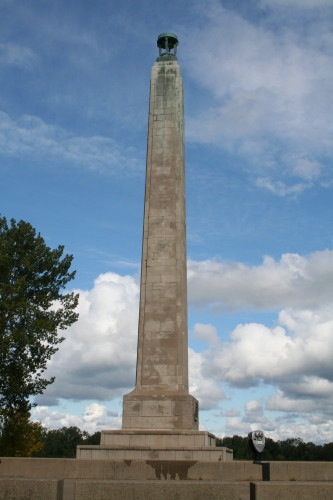
Perry Monument


Today is another rainy day in Pennsylvania. We had planned to drive up to Presque Isle State Park on Lake Erie. Since we don’t have many days here we hated to loose today to rain so decided to go up to the Tom Ridge Environmental Center at the entrance to Presque Isle. We set out early, but when we got there it was closed not opening until 10 AM. Also at the entrance of the park was one of the vintage diners we wanted to see, so we thought we’d wait for Tom Ridge to open drinking coffee. That turned out to be closed as well. Our next thought was to drive into the park. We could look around a little between the rain drops. We got started and couldn’t stop. What a wonderful place.

Presque Isle is a very narrow peninsula approximately 5 miles in length jutting out into Lake Erie at about a 45 degree angle. The road makes a loop along the perimeter with Presque Isle Bay on one side and the Great Lake Erie on the other. Also paralleling the road is a 13-mile long paved path for biking, walking, and jogging in warm weather, and snowshoeing and cross country skiing in the winter. There are also a few miles of woods trails for hiking scattered about the park. There are many inland ponds and small bays which are fabulous for canoeing and fishing. We found one quiet bay area with houses scattered around the bay. They were in a real sense house boats, but they were definitely not boats. We couldn’t decide if they were privately owned or park rental units for visitors. On the lake side were perhaps 12 picnic areas along the sandy beach of Lake Erie.
Presque Isle Bay
North Pier Light

There is a Coast Guard Station on the tip end of the peninsula and about midway on the Lake side is the Presque Isle Lighthouse. We got good views from the beach, but we could not get too close to the light since it is now a private residence. Our guess is that the local Park Ranger lives there or perhaps someone who has volunteered to maintain the structure.
Picnic area on Lake Erie


Presque Isle is the place where Commodore Perry hid out from the British while building his ships. He went from here with his fleet to win the battle against the British in the War of 1812. Naturally, to show our gratitude, a memorial has been erected in his honor at Misery Bay were Perry’s men wintered on their ships following the battle.
Misery Bay

Little house boats on Horseshoe Pond
Presque Isle Lighthouse

Gene had a conference call at noon so we couldn’t stay as long as we would have liked. If we get a chance before we leave here, we’ll go back. Besides, we never did get to visit the Tom Ridge Environmental Center.