Thursday, August 7, 2008

Olympic Lake Placid

1980 Olympic Center
Lake Placid is all about the Olympics, especially the 1932 and 1980 Winter Games. They are also all about making the Olympic Venues available to the tourists, who has cash in their pockets and who is all about seeing what there is to see.
1932 Olympic Stadium
1932 Ice Rink

Today we did something we rarely do—bought the admission package ticket to see it all. Our campground had made it clear we should not go anywhere without checking in the office to see if they had discount tickets. This morning, doing as we were told, we stopped by the office on our way to Lake Placid to check out the Olympic stuff. I had wanted to see a couple things—the Olympic Center and the Ski Jump towers. What the office had was a discount package ticket for both these things plus the Olympic Museum, the Whiteface Mountain stuff and the Bobsled/Luge Run. Plus the tickets were good for the rest of the time we are here. We could do some today and some another time. That’s great. We took our tickets and off we went.
1980 Ice Rink
Bobsled and luge runs

Our first stop was at the original Olympic Center which houses the ice rink used in the 1932 games. Still in use, there were Olympic hopefuls out on the ice today. I was most impressed with the seating capacity. It was really very small with only a few hundred seats. The original building had to be added on to, of course, for the 1980 games. Here we were able to walk into the rink where the American Hockey team defeated the Russians in 1980. Next, we spent a little time in the Olympic Museum. It was small but packed full with memorabilia from various Olympic games.
Bobsled Run

After our picnic lunch we went over to the Olympic Sports Complex where we got a tour of the Bobsled and Luge Run. It was used in the 1932 games and is still used for practice and for some competitions, but because the sleds have gotten much faster over the years, it was not used in the 1980 Olympic games.
Olympic torches
Ski jump model

The rest of the stuff on our “see it all” tickets we’ll save for another day.
US hockey team stuff

On our way home we stopped by the Sugar Maple Farm. Of course, it is not sugaring season and we don’t plan to be here in the winter when it is. We just wanted some good maple sugar.
So many choices

Wednesday, August 6, 2008

Out With The Camera

A natural flower box


Today was another rainy day so we decided to get some shopping chores done. Our prescriptions needed refilled so that required a trip to Walmart in Plattsburgh. I had been looking forward to visiting Plattsburgh because I wanted to do one of the two walking tours I had read about. One was along the Saranac River and the other seemed to be along Lake Champlain starting at the City Beach. We had visited Burlington, Vermont, just across Lake Champlain from Plattsburgh, a couple years ago and were very impressed with the city. I am expecting as much from Plattsburgh. However, today was not the day to find out. We had put off making this trip because of the rain, but, alas, medication calls and we had to get that taken care of. So in the rain we made our way to Walmart and to Hannaford for groceries. We also went down to the Farmer’s Market, but I was really disappointed there. Perhaps the farmers stayed home because of the rain. There were only 2 vegetable stands. The highlight of our trip was the wonderful pizza we shared at a small, local Italian eatery across the street from Walmart. Maybe we will get a chance to try Plattsburgh another day.
Clouds over the mountain

I usually have my camera with me wherever I go, even if it is just for a walk around the campground. Occasionally I stumbled onto something that catches my eye. Here are a few photos I like.
Club moss with birch bark

I found the half rotted log covered with flowers in front of a shop in Lake Placid. The log had been hollowed out somewhat to create a “flower pot”.

One thing about the rain—we have a tremendous mushroom crop.

Enjoy the photos.

Tuesday, August 5, 2008

The Flume


Have I mentioned that it has been raining in New York? It has rained everyday since we moved to Wilmington. Apparently, it is very unusual to have this much rain. We are noticing the weathermen saying “sorry” at the end of their forecast. We really didn’t mind. After all, we are from Tennessee where drought conditions have been a major concern for a couple years. So we always welcome rain. Well, I finally got tired of it yesterday.
A stone wall

One of the luxuries of being in an area for an extended amount of time is that you can wait for the “perfect” day to do some particular activity that is high on your priority list. There is only one thing we really want to do while we are here which weather can make or break—climb Mt. Marcy. It is going to be a hard hike and since we haven’t done anything that difficult in a long time, we wanted to “practice” first. Our practice mountain—Whiteface. We have been waiting and waiting for the skies to clear. All last week the weatherman kept saying that Monday looked like it would be a dry day. We made our plans to climb the mountain.
A wet, boggy Wilmington Trail

The campground boasted of a trail at the back of our section which connects with the Wilmington Trail, the favored trail to the summit. Careful scrutiny of all the maps we have gave no indication of such a trail. Not wanting to find ourselves in a bind on Monday, we decided to scout the campground trail on Sunday afternoon (in the rain). Sure enough, the trail exists and goes right to Wilmington Trail. However, we estimated it to be about a mile one way and it hit the Wilmington Trail just a stones throw from the trail head. No thanks, I’ll drive around.
An old toboggon shelter

Well, our attempt to hike up Whiteface Mountain yesterday was unsuccessful. By Monday morning the weatherman had changed the forecast and was saying that there was a 30% chance of rain. We decided to go anyway because Gene couldn't go on Tuesday because of his work and the rest of the week is supposed to be raining. So we struck out bright and early. It got cloudier and cloudier with every step we took. It would drizzle a little bit then stop. About the first mile and a half was pretty good--almost level and pretty dry, not many rocks. After that it got really steep. We climbed 3000 feet in the next 2 miles. For you non-hikers, that’s very steep. The drizzle kept up so the rocks, and there were plenty of them, were wet and slippery. About the time we got to where the trail leveled off some it came a downpour. Since the trail was more flat, it held all the water. We much have walked for half a mile with water over our boots. With the rain, and the rocks, and the mud puddles we had only gone about 3 and a half miles in 3 and a half hours. It was about that time that I looked up and as far as I could see down the trial was a puddle who knows how deep. We still had almost 2 miles to go so we decided to turn around. We got another downpour on our way back to the truck. We were soaked with mud by the time it was all said and done.
Flume with Whiteface Mtn in background

So, since the weatherman said that now Tuesday was going to be dry day this week, I decided I would just drive to the top of Whiteface Mountain. I got up and got my stuff done so I could get an early start. I went down the road about a half mile from our campground to take a couple pictures of the river. I happened to look up at the mountain and saw it was in the cloud. I didn’t want to pay the fee for the drive up and then not have any views once I got there. So I did laundry instead; and it rained this afternoon.
Flume

The photos were taken at fleeting moments of sunshine on our hike up Sunday. We were surprised to find a stone wall along the trail. This type of stonewall is common in the South. Farmers cleared the stones from their fields (themselves or their slaves). The stones were simply piled along the edge of the field or property boundary. Here, however, a trench of sorts must be dug to create a foundation layer of stone to prevent the frost heaves from pushing the wall over.

The photos of “the flume” were taken this morning. Over time the Ausable River and geological changes of the area has gouged out a gorge. With the heavy rains the river is full forcing its way downstream. Pretty spectacular.

Monday, August 4, 2008

Backpacking in the Adirondacks

We had originally planned to hike up Mount Marcy, New York’s high point, as a backpacking trip. After studying the map and guidebook, we have decided to do it as a long, almost 15 mile, day hike. Since we don’t have plans for another overnight trip, and therefore wouldn’t have a personal experience to relate, I wanted to share what we learned about backpacking in the Adirondacks.
A typical lean-to

This is almost a perfect time of year for backpacking in the Adirondacks. The nights are cool and the days are pleasantly warm, but not hot. And it is past black fly season. There are regulations, of course, for backcountry camping. The New York State Department of Environmental Conservation manages Adirondack Park and, like their name implies, their job is to conserve and preserve this great wilderness area.
Campsite on Copperas Pond

Generally, the guidelines are typical of those found at most National Park and National Forest areas. Camping is permitted anywhere so long as it is 150 feet from roads, trails, lakes, ponds, streams, etc. There are some designated camping areas adjacent to lakes and ponds. A permit is required for stays of longer than 3 days in any one area or for large groups. Pets are allowed, but they must be kept under control and their waste must be buried. Different rules apply for the High Peaks Region. There is no camping permitted above 4000 feet (above tree line) and camping between 3500 and 4000 feet is at designated camping areas only. Food must be stored in bear canisters during spring, summer, and fall in the High Peaks Region. There are lean-tos, or shelters, scattered about the park. These are available on a first-come, first-serve basis and they cannot be used exclusively by a single group.
Campsite on Owen Pond

In our hiking we have seen several lean-tos and several backcountry camp sites. The lean-tos are very similar to those 3-sides shelters along the Appalachian Trail. These have a peaked roof with very little overhang in the front. They are a log structure with a sleeping platform which will accommodate about 6. The ones we’ve seen have been very clean. There is a rule here that forbids the use of a tent inside the lean-to. I guess they saw me coming.

The designated camping areas we have seen vary widely. Some are very nice with large flat areas to pitch a tent on root-free, soft ground, covered with pine needles. Others have been rock and root littered on slops a goat couldn’t stand on.
This is too rocky and not level enough for me.

While hiking, we always look around for a good camping spot. It’s an affliction we have that goes back many years. As we are hiking here we are again on the lookout for a great place to pitch a backpacking tent. Of course we haven’t done a lot of hiking here, but were we’ve been, we haven’t seen hardly any campsite we would consider suitable other than the designated camping sites. This may be due to the fact that we are hiking in or near the high peaks region and the trails are on steep mountainsides. Also, this has been an unusually wet season with rain just about everyday. The few areas that are flat enough for a campsite are too wet to use.

Still, this is a beautiful area for the backpacker with many lean-tos and designated camping areas provided just for your enjoyment.

Sunday, August 3, 2008

Budgeting for the RV Lifestyle, Part III

We worked hard at saving our money and we got the RV we wanted. Now, how do we manage to live within the budget with fuel and grocery prices much higher than we anticipated? It’s not easy and we look at the budget a lot. However, there are a few things which we have learned from other RVers as well as a few things we have stumbled upon ourselves.

The cost of fuel has been the biggest concern lately. What we, and other RVers, are doing is staying in one location longer. Instead of going somewhere for a week or two then moving on, we are staying for a month. Monthly rates in campgrounds are considerably cheaper than weekly rates. (Not all campgrounds offer monthly rates) We save on the campground fee plus we are not towing. We may not get to see as much of New York as we want, but we would rather make that sacrifice than give it up all together. Occasionally we have a situation like the one we are in currently. Where we want to be is the high peaks region of the Adirondacks for the hiking. Every campground in the area is above our budget. To be farther away would get us a cheaper campground, but we would spend much more on fuel. We chose to stay close, drive less, and hopefully make up some of the costs by boon docking occasionally on our way back to Tennessee.

We also belong to a couple RV clubs which offer discounts at some campgrounds—Escapees and Good Sam. AAA members can get some pretty nice discounts, also. We are not old enough for the government discount card, but we are looking forward to the Golden Age Pass, now called the America the Beautiful Pass for seniors, for half price admission to the national parks and the Corp of Engineers campgrounds. While we are talking about passes, let me say that each year we look at where we are traveling in relation to National Parks. If there are several National Parks on our itinerary, we purchase an annual pass to save on entrance fees.

When we made our initial budget, we based our monthly allotment for groceries on prices we were spending in Nashville. Prices across the country vary greatly. We do pretty good staying within the grocery budget by selecting foods that are on sale, eating less expensive cuts of meat, or frozen instead of fresh vegetables. I have never been one to clip coupons, but some folks save a lot by taking the time to do that. Some groceries have what they call “senior days” when they give an additional discount to shoppers over a certain age.

Our great love is hiking and, although it may be free to walk the trail, it is not a free activity and good boots and gear are very expensive. We offset some of this cost by using an REI credit card which pays a small dividend. There is no skimping on boots and socks, but we have gotten into wearing shirts and shorts from WalMart rather than the outrageously priced Exofficio and Patagonia brands from the outfitters.

Now a quick word about work camping (workamping). Many, many, many fulltime RVers supplement their income by working at campgrounds, National Parks, state parks, and various other establishments across the country. Often these jobs offer minimum wage, a free campsite, or both. Some are for a season, others for a month or two. This is very appealing and we have thought of doing it often. I could handle dipping ice cream at Yellowstone a few hours a week and spending my off time in that great park. Technically, Gene is a work camper since he is working his job from the Montana.

My point in all this--we have to stay within the budget. If one area is overspent, then we have to compensate for it in another area or make up the difference later on. With the rising costs of just about everything, it is a difficult juggling act at times. For us, juggling and sacrificing is preferred in order to live our dream.

Saturday, August 2, 2008

Budgeting for the RV Lifestyle, Part II

Our original dream had been to retire at age 55. When that time came we found that full retirement was just not financially feasible. We could, however, take 6 months off and work 6 months. Six months off was better than no months off—you do what you can. About the same time, we got the idea that we might like to try fulltime RVing. Now that we had worked all these years on this retirement plan, how would we adjust our budget to accommodate RVing?

Before we did anything too drastic, we wanted to be sure full timing was what we really wanted. Our first 6-months off was only a few months away, so instead of spending a lot of money on a camper, we just bought a bigger tent and a couple folding cots. We had everything else we needed for camping. That first summer we spent in Colorado and loved every minute of it. We were outside, we were hiking and exploring the country. We were convinced we would love RVing. But we had a little problem—we still had to work 6 months of the year.

We went back to the budget to see what adjustments needed to be made to accommodate 6-months on the road. We learned that first summer that tenting was good for a week or two, but was difficult for an extended time. I guess the main problem was cooking and eating outside in all kinds of weather. We felt we would be more comfortable in something that was somewhat more self-contained but we didn’t want to spend a lot of money and we also had the issue of where to store a camper during the working months. Additionally, we had a relatively new Honda van so we wanted something that it could tow. A pop-up camper seemed about perfect.

Making that decision brought on a whole new set of questions. Where would we get the money for the pop-up, the additional insurance costs, the additional fuel cost, etc. It occurred to us that if what we really wanted to do was fulltime RVing then we needed to be thinking like fulltimers. We didn’t need a house!! Neither did we need two cars. The money allocated to electricity, water, sewer, taxes, insurance, maintenance fees, car registration and tags could all go to the pop-up. That problem solved, a new one came in its place. We could spend the summer months in a pop-up but we could not spend winters in Tennessee in a pop-up. A little research and investigation proved that it would be cheaper to rent a small apartment for the winter than keep the condo.

We spent 2 summers in the pop-up and had a blast. Moving into an apartment each fall and out again in the spring was not so desirable. So back to the budget we went and back to the RV dealerships. One thing that had been a great blessing that we had not counted on was that Gene was able to continue working for the company where he had been working for many years rather than at a minimum wage temporary job. That allowed us to continue saving his excess salary. With a few adjustments to the budget (seasonal campground fees were less than apartment, furniture, and storage unit fees) and a good trade in on the Honda, we felt comfortable with purchasing a 5th wheel.

With an RV large enough to live in it would require more fuel to tow, a larger, more expensive campsite, and a pretty good pile of money for maintenance. The best solution for providing for that money was to continue to work for 6 months each year for a couple or three more years. That’s really not so bad. It’s not our dream, but having 6 months off really boosted your moral and went a long way toward making those working months better. Plus, we were technically fulltime RVers.

So, now that we are on the road, how do we adjust the budget for rising fuel costs? Answers tomorrow.

Friday, August 1, 2008

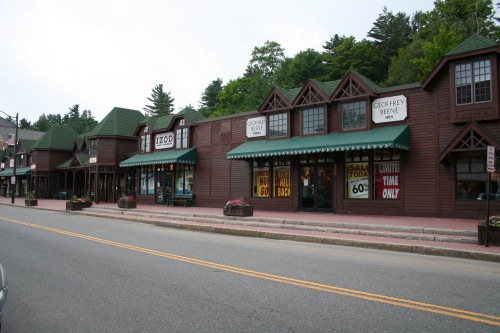
Main Street, Lake Placid


Made famous by the 1932 and 1980 Winter Olympic Games, this small community draws the sports enthusiast year round. And rightly so with such events as Ironman USA, Ice Dance Championships, and a Sports Film Festival. There are horse shows, marathons, bike races, and a BBQ Festival. I certainly don’t want to fail to mention the shopping opportunities. There seems to be something for everyone. It was here in 1980 that the US Hockey team beat the Soviets. I was in a Mexican restaurant in Detroit when that event happened. The whole place went up in a roaring cheer.

Today we drove the 10 miles from our campsite to Lake Placid. We needed a few things from the grocery. The Little Supper Market around the corner from us is truly little and we needed more then it had to offer. So here we are for the first time in Lake Placid. Our impression is that it is a very up scale tourist village. Main Street is for shopping and the shops offer antiques, high quality arts and crafts, fine art galleries, coffee shops, delis, outdoor dining, and sporting goods.
Outlet Mall with an Alpine feel
Plenty of outdoor eateries

About midway along Main Street we came to a small park and the band shell. Overlooking Mirror Lake it was a great place to sit, relax, and enjoy the view—just soak all the goodness up.
Mirror Lake

We were in a bit of a hurry this afternoon, so didn’t spend much time. Here are a few shots of Main Street and Mirror Lake. We’ll be back to investigate further.
Starbucks, of course