Thursday, May 8, 2008

Shelters, Tents, and Trail Towns

We get several questions from non-hikers, but perhaps one of the most frequent is “where do you stay” when hiking the Appalachian Trail. So let me say this about that.
Bunk house at Woods Hole Hostel, VA

Scattered along the length of the Trail about a days walking distance apart are shelters which offer weary hikers a place to bed down for the night. Most often these structures are 3-sided lean-tos without electricity or any other creature comfort. They are simply a shelter which, if you are lucky, is dry. They have been built usually by volunteers, to which we hikers are eternally grateful.
Our cabin at Rainbow Springs, NC

Gene and I, however, prefer to sleep in our own tent rather than these rodent ridden hovels. I don’t think there is a shelter along the AT that doesn’t have an infestation of mice. In Georgia on our first section hike, we saw a tally of the number of mice killed. We met a hiker in North Carolina on our third section who carried a supply of mouse traps and left one at every shelter he came to. It has always been my opinion that where there are mice, there are snakes. I’m not going to be a part of that party if I can help it. So, as heavy as they are, we carry a tent.
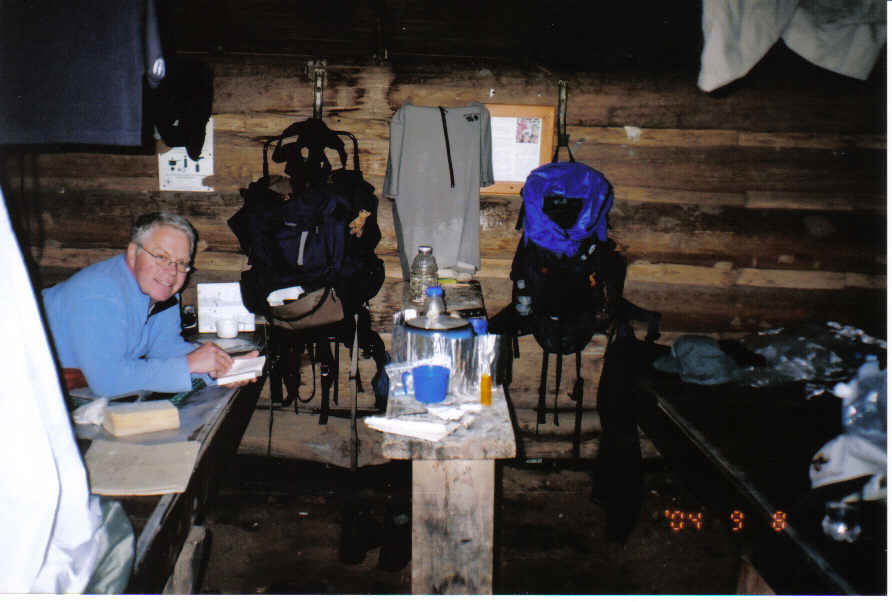
We stayed at Roaring Fork Shelter, NC to wait out a hurricane.  We had the place to ourselves.

We pitch our tent near the shelters, of course. The shelters, after all, are usually at a good water source. Water is essential for cooking, but is very heavy to carry for any distance at all so we want to camp as close to water as possible. The weather is not always perfect when you’re on the trail, either. The shelters offer a dry, flat place to cook. The shelter areas generally have a relatively flat space to pitch a tent. Flat spaces large enough to pitch a tent are often hard to find as you trek along the mountain side. The shelters are where most hikers spend the night, and if you want some company, that is the place to be. Since many, many hikers stay at the shelters, there is often a privy provided. I much prefer a privy to digging a hole. For these reasons, we usually pitch our tent near a shelter.

There have been times when we have stayed in the shelter. In the Smokies, for example, tenting at a shelter is prohibited. Tenting anywhere in the Smokies is prohibited except at designated backcountry campsites. I spent over a hundred and fifty miles (almost from the time I left Springer Mountain until I got to Fontana Dam) worrying about how I was going to spend the night with whatever else was living in the shelters in the Smokies. Over those many miles, I finally came up with a solution to my problem. I would create for myself a safe haven inside my tent body. It works perfectly. I (or usually Gene) use a length of rope to attach the tent to the rafters inside the shelter. Inside the tent, I am safe from any creepy crawlies that may roam the shelter at night. One of the best shelters on the trail is Partnership Shelter at Mt. Rogers Headquarters. It has a shower and there is a telephone at the headquarters building. We called for pizza delivery and had dinner at the picnic table with Tin Cup and Just Mike. Fantastic.
My safe haven when staying in a shelter

About every 4 to 6 days, the trail will come to within striking distance of a town. We have to get off the trail to buy more food so we might as well spend the night. Trail towns often have really cheap places for hikers to stay, usually hostels. I’ve stayed in a few, but greatly prefer a motel. I like having my own bathroom and the privacy a motel offers. Sometimes a hotel will have a coin laundry which makes life so much easier. Several times we have stayed in B and Bs and a couple times in cabins. Age has it’s advantages, I guess. We are not on the shoestring budgets that so many of the younger hikers are and can thus afford better accommodations while in town.

On our first AT section, when in town, we would stay two nights. Hike into town one day, take the next day off (a “0” day), then back to the trail the following morning. We found, however, that the “0” day was just too boring. We started planning our mileage so that we would arrive in town no later than early afternoon. This would give us enough time to get food bought, repackaged, and laundry done that same day. Then we were back to the trail the next morning. This has worked well for us. We still take the occasional “0” day but not every time we’re in town.

Blood Mountain Shelter, GA
That is just about all I have to say about “where do you stay”. It may be more than you ever wanted to know.

Wednesday, May 7, 2008

Appalachian Trail, Section One

Before I start my section hike in a few days with hiking buddy, Diane, I wanted to include a few posts about our other sections on the AT.  This first section was my first on the AT, but Gene had previously done several hundred miles from Springer to somewhere in Virginia as well as the 100 mile wilderness in Maine.  This story took place in September, 2003.
The Southern terminus of the AT--Springer Mountain, GA

Most folks who aspire to thru-hike (complete the entire length of the trail in one season) the Appalachian Trail begin at the southern terminus, Springer Mountain in Georgia. They start at Amicalola Falls State Park and hike the approach trail to the beginning of the AT. Even though we were doing only a small section, we thought we might as well begin at what most would consider the beginning. Gene had previously hiked the approach trail which is a difficult climb and personally I just can’t see doing a bunch of hard miles that won’t even count toward the AT mileage. So we opted to drive up US Forest Service road 42 and hike the mile back to the beginning at Springer Mountain. We were already in Georgia for a family reunion over the Labor Day weekend and my parents were kind enough to go with us to the trail and drive our car back to Nashville.
Repacking food at Neel's Gap, GA

My mother is real fond of picnics and to get us started we had a little tailgate party. She is also a hiker and began our journey with us as we hiked back to the beginning of the trail. We all signed the trail register. Then we were on our way north. This first section was from Springer Mountain, GA to Newfound Gap in the Smokies—a distance of some 200 miles. We had the month of September for the hike.
Our new tent which we bought at Neel's Gap.  Sierra Designs Astroid

We had read book after book written by those who had hiked the trail and we had soaked up all the information we could from the internet. We were as prepared as well as we felt we could be, however, no amount of reading can prepare you for the real thing. For that matter, no amount of day hiking can prepare you for the long distance hike. Perhaps the best thing we did was to keep our daily mileage low. We didn’t go out there in race mode. We set a pace of about 8 miles a day and gradually increased to 12 a day. The mileage was low enough, especially in the beginning, that we were not totally exhausted when we got to our camping place at the end of the day. We had time to relax and clean up before dinner. It made the whole hike more pleasant.
Drying out very wet boots at Fontana.

We were lucky with the weather that first section. It rained several times, but often the worst rains were the day before we were in town. Being able to dry out gear and wash wet clothes is a big morale booster. Of course, two of the worst rain storms I have ever been in occurred on this section, but in both instances, we were just a day out of town. How lucky can you get. The first of these was the night before going into Neel's Gap when the tent leaked and we had to buy a new one. The other was the day we went down into Fontana.
Albert Mountain

Although we had been on many weekend backpacking trips and had spent a week in the high Sierras, this was the first time for a hike of this length. We quickly learned we needed to become for efficient, especially in pitching and taking down camp. Our tasks emerged and we soon became a good working team. When we arrived at our camp site for the night, Gene would usually help me pitch the tent then he would fetch water while I got sleeping gear unrolled and organized inside the tent. We like getting into camp early enough to wash up before dinner, which meant many mornings we were up before daylight. Gene would get the food down and start coffee while I stuffed sleeping bags and rolled pads. We were satisfied with our routine in the afternoon, but we never got the morning to where we were completely comfortable with our performance.
On the trail as it goes through the breezeway at Walasi-Yi Center at Neel's Gap

The whole trip was a great learning experience. Perhaps my journal entry for the last day of our trip says it best.
Looking toward the Smokies from Wayah Bald fire tower.

Gatlinburg—BestWestern. 203 miles. I did it!! What a great feeling. The trail was a challenge right up to the last step—up and over Clingman’s Dome in a misting rain and cold wind. As we passed Little Indian Gap the sky opened up and the rain poured down on us as we went over the last mountain before Newfound Gap. Salamanders shared the trail with us. Once again, soaked to the bone. But what a wonderful sight mother was as we crossed Newfound Gap Road. I am filled with mixed emotions. The shower and dry clothes are wonderful. I want to see family and friends. But I don’t want to leave the trail. It has been a great experience and I don’t want to let go.
At Nantahala Outdoor Center

It was on this first AT section that I discovered I enjoyed long distance hiking.

Tuesday, May 6, 2008

Bowling Green, Kentucky

We arrived in Bowling Green this morning--a short 70 miles from our campground in Nashville. We are here for the Life on Wheels conference which starts Wednesday.
Fountain Square Park

This afternoon we took a couple hours to tour the historic downtown area. The “square” in this town is typical of squares across the south. The original log courthouse is no longer on the site. Instead, the center of the square is occupied by Fountain Square Park. This 2-acre plot of land became a park in 1870. In 1881, the city bought the 6,000 pound fountain from J.L. Mott Ironworks of New York which is the centerpiece of the park. Hebe, goddess of youth, is on top. The current courthouse is located in the next block.
Taking care of business

After touring around town we sat for a few minutes in the park. We were enjoying the light breeze and beautiful sunshine. Gene did have to spend a few minutes on the phone with the office, but not so many. Also on the square was a small coffee house. At dinner this evening when Gene asked me what my favorite part of the day had been, I finally selected the time we spent in the coffee house, but Fountain Square Park was a close runner up.
Bowling Green Courthouse

One of Bowling Green renowned citizens was Duncan Hines of boxed cake mix fame. In fact, I have several of his products in my cupboard at this very moment. Duncan was a traveling salesman in his day. He spent a great deal of time traveling across America and eating at local restaurants. He compiled a list for his friends of restaurants where he had gotten a good meal. This list became quite popular and eventually was published. He did the same for good hotels.

The quote of the day--"If the soup was as warm as the wine, if the wine was as old as the turkey, if the turkey had breasts like the maid, it would have been a fine dinner." - Duncan Hines
Coffee break

One attraction here, which we probably won’t have time for during this trip, is the National Corvette Museum. We’ll have to put that on our list for another time.

Sunday, May 4, 2008

On The Road Again

We are preparing to leave Nashville on Monday. It has been a great 3 weeks. We have had the opportunity to visit with several of our friends and most of the family who live in the area, plus a trip to Georgia to visit with my brother, nephews, and the new great nephew. But I get hitch itch after about a month, and I am feeling that longing for the road.
Practice pitching the tent

We are heading to Bowling Green, KY for the Life on Wheels conference, then to Virginia and the Appalachian Trail. I am looking forward to the LOW conference. This will be our first conference, rally or anything like this. We have heard how much fun they are.
It is so small

I am especially anxious to get started on my hike. I don’t want all that training in Erwin to wear off any more than it has. Besides visiting with friends and relatives, I have finalized my plan for the hike, made out my menus, bought and repackaged food and carried the full pack on my back for a couple hikes. I have also practiced one last time pitching my tent (it is still tiny), working with my stove, and purifying water.
At least I can sit up inside.

Thursday, May 1, I rolled up my sleeves and got all the monthly chores done. I didn’t want to leave Gene with the task of defrosting the freezer or vacuuming out the weep holes. He is such a Type A personality that if he knew they weren’t done he would be right in there doing it. I’ve already made him a list 2 pages long of things to do for me and the cat while I’m on the trial.
Practicing lighting my stove.

Thursday evening we had dinner with two couples from the Montana Owners Club. We had never met either couple, but felt like we are long time friends with Bill and Helen. We regularly keep up with them through their website which was how we discovered they were in Nashville for a few days.
Practicing treating water.

Friday I had time to visit with my friends in the lab at St. Thomas Hospital. These people occupy a special place in my heart. I worked there for a number of years on every shift and in several departments, but it was the folks in anatomic pathology that got me through college. They were happy to let me work flexible hours to accommodate my class schedule. I couldn’t have done without that benefit. The pathologists were invaluable in their support. Dr. Lou taught me how to sharpen knives on the stones (that was a long time ago, they use disposable knives these days) and I used that skill as a demonstration in my first speech class. It was good to see them and catch up on the gossip.
Reminds me of chemistry class

I had lunch Friday with my good friend and teaching partner, Karen. We are both retired now, but we taught for years on the same team, and our conversations together outside of the school setting were filled with almost nothing but lesson plans, students, and what the chances of a snow day were. I got in the truck after our lunch and realized that other than inquiring about mutual friends, neither of us had mentioned anything about school.

So, today we are securing the Montana for travel, checking the tires and filling up with fuel. We are pulling out bright and early Monday morning.

Saturday, May 3, 2008

Haircut Day

Thursday was haircut day for Gene. I cut his hair. He cuts mine, too, but we’ll get to that later. This started the first year we had 6 months off. We were camping in a tent that year and traveling in our Honda van. That year was a real experiment for us to see if we really liked being on the road for an extended period of time as well as seeing if the semi-retired budget would work. Not working is real incentive for cutting expenses and we looked at every dime we spent to see if we could make adjustments. One item that was ultimately eliminated was the regular 6-week haircut.

Off to Wal-mart we went to purchase our very own hair clippers. The first set we bought included a short video—a complete barbering course in just 30 minutes with no hands-on experience required. I watched the video and it looked easy enough. Even if you don’t purchase the clipper set with the video, there are printed instructions for the “perfect” flat top and crew cut.
Before

It was difficult for me at first. Even though you may think you would like to come at your husband with a cutting instrument, it was hard to make that first move. It was pretty difficult for him to sit at the picnic table, waiting, knowing I could do some serious damage. He was very supportive, though, and we both knew that the world was not yet without professional barbers who would be happy to fix, and laugh at, whatever mess I made. We also found that a couple cocktails helped both of us.

One of the first haircuts was at Mesa Verde National Park. I don’t think it ever occurred to us that we might be camped at an area without electricity. We take electricity for granted but the National Park Service doesn’t and the campground at Mesa Verde is typical of most national park campgrounds—electricityless. This might not have been such an issue if we had remembered at the previous campsite with electricity to charge the clippers. But we hadn’t and it was past time for a haircut. The only place in the campground with electricity was the bathroom so we ventured over to the farthest one from the campers. We used the ladies side and cleaned up our little mess afterwards.
After

Since that first summer, I have cut Gene’s hair every 6 weeks or so (now without the aid of a cocktail) with the exception of one time. He felt he could spring for a professional cut for his daughter’s wedding. We figure that is a savings of $15 per cut every 6 weeks since 2003 less the cost of 2 sets of clippers at $30 each. That makes approximately $580!!

Gene has cut my hair a few times. So you see there is a reason why I leave my hair long and pull it back. After one of his cuts I usually have to tilt my head to one side or the other to give the illusion of an even cut.

Friday, May 2, 2008

Driving In Nashville

Let me just say from the beginning that I don’t like heavy traffic. I think I have always felt this way, although I have lived most of my life in large cities, and you would think I would be used to maniac drivers and high speed merging interstate traffic. Driving on Nashville interstates makes me a nervous wreck.

One can get here from almost anywhere. Three major interstates converge on Nashville—I-40, I-24, and I-65. A commuter can zip from interstate to interstate by means of I-840, I-440, or Briley Parkway. For the Nashvillian, or anyone familiar with the layout of the city, you can create a route utilizing any or all of these routes as well as numerous other 4-lane surface roads to move yourself about the city in what a New Yorker would consider no time at all. Perhaps it is this familiarity that results in the high rates of speed at which I am passed by other motorists.

To save myself, I have taken to the side streets. It takes lots of practice and fortitude to navigate the surface streets of this city. It helps to know the lay of the land. The downtown area is built from the Cumberland River and spreads outward. Because Nashville is built on a bend in the river, the result is like a wheel with the downtown area being the hub and the main roads like spokes in the wheel. A true grid is impossible in this situation. Two roads that might be miles apart on the outskirts of town will only be a few blocks apart in the inner city.
Support for .... nothing?

This is still a relatively easy configuration to navigate, so apparently the city planners go to great lengths to keep you on your toes. This is not as bad as it used to be, but you never know when a one-way street will have its direction changed. Or you may be motoring along, minding you own business and the street abruptly come to an end. This is particularly disturbing when it picks up on the other side of whatever the obstacle is in your way. This is especially true of 8th Ave. On the south side of Broadway out as far as 100 Oaks Mall, 8th Ave goes by the name of Franklin Road. As you make your way into town, the name changes to 8th Ave. So. Crossing Broadway it becomes 8th Ave No until you get to Charlotte Pike where it suddenly stops at the Capitol Building. If you turn left on Charlotte and then almost immediately right onto the ramp to James Robertson Parkway and continue to the first traffic light, you will find 8th Ave No again intersecting James Robertson. Broadway is Broadway downtown, West End Ave in midtown, Harding Road in Belle Meade, and Hwy 70S in Bellevue. Who could keep this straight?
Look, ma, no road.

It seems like there is construction everywhere. One of the worst construction projects since the Romans started building roads was the Briley Parkway endeavor. Construction started sometime in the 1970s and was finally finished last year. As a part of this project I-40 got a new ramp or two. I like to think the powers that be were planning ahead when they stuck up a support beam with nothing to hold up and a ramp that goes to nowhere. In all fairness I must say that Briley Parkway is a fine road to take now. Technically, it loops around the city, but the driver must know that, depending on where you are on the loop, Briley Parkway may also be called Thompson Lane, Woodmont Ave, or White Bridge Road.

Thursday, May 1, 2008

It Was a Simple Task

It is time to change the ceiling fan from winter rotation to summer rotation. It is a simple task—just flip the switch. That is what Gene was going to do. However, he needed something to stand on as the fan is beyond his reach.

His lift of choice for any job inside the Montana is never the small folding step stool but a dining table chair. These chairs are of solid wood construction with a thick cushion over the seat. The cushion is attached to a square of particle board which is hinged to a 4 inch deep box creating a fantastic storage compartment. There is no storage that is left empty in our Montana. Each chair is as full as it can be with a wide assortment of stuff.

He moved the chair beneath the fan and looked up to be sure of his positioning. He noticed there was some dust on the fan blades and thought he would just take care of that while he was up there. After getting a dusting cloth, he stepped up onto the seat of the chair and was startled by the clink and sudden shift in the chairs position. He had inadvertently placed one leg of the chair on the floor vent. Miraculously, the slat in the vent did not break as it had the last time he stepped up onto a chair that was resting on the vent.
All that stuff fell out of the chair seat.
Surprising how much stuff will fit in that small box.

Between the vent slats was the small coaster from the bottom of the chair leg. I guess, to verify that this truly came out of the bottom of the chair leg and to confirm that he would be able to easily fix it, he turned the chair upside down. This caused the hinged seat to fall free and the entire contents tumble onto the floor. The coaster was bent to such an extent Gene was unable to fix it with our meager collection of tools. The fan, however, has been dusted and switched to summer rotation mode.