Showing posts with label National Park Service. Show all posts

Tuesday, July 26, 2011

Wrangell St Elias National Park


The rain, which started on Saturday afternoon, continued through most of Monday.  Late  Monday afternoon we began to see some break in the clouds.  The bit of blue sky got our hopes up for better weather for our travel day on Tuesday.

We took the motor home in for service Monday morning.  Other than the oil change, they found nothing else which needed attention.  Always glad to hear that.  This morning we filled up with gas, propane, and fresh water and emptied the waste tanks.  We finally got started about 9:30.


Our destination for the day was Glennallen at the junction of the Glenn Highway and Richardson Highway.  I guess, all things considered, it was a pretty nice drive across the Glenn Highway.  The road was in good condition, although curvy and narrow from Palmer to Sheep Mountain at mile marker 110.  About a third of that first part was excellent on relatively new road with three and sometimes four lanes.


We made a stop at Pinnacle Mountain Cafe, Lodge, and RV Park to look at their collection of antique tractors.  We made a couple of other stops at pullouts to admire the views.  We had excellent views of Matanuska Glacier for several miles.

Matanuska Glacier
Then we ran into road construction for a 9-mile stretch, 2 miles of which we were guided through by a pilot car.  That was a first for this trip.  After the nine miles of construction, we had rough road all the way to Glennallen at mile 189.  The road surface was not so bad, but there were many frost heaves.  Driving was very slow.

Sheep Mountain Area
It was a very scenic drive.  The Sheep Mountain area was gorgeous and we passed many, many lakes and ponds.  We were surprised not to see any moose.

Before stopping for the night, we drove south on the Richardson Highway for about 10 miles to Wrangell-St. Elias National Park.  This is the largest National Park in the United States.  It is larger than Switzerland and has higher mountains.  The St. Elias mountain range is the highest coastal range in the world.

Portion of Valdez Trail
This is a magnificent park, but accessibility is limited.  There are two gravel roads which lead into the park.  One is off Richardson Highway going about 40 miles into the park to McCarthy and the other is off the Tok Cut-off at Slana.  Otherwise, river access or air taxi is the only way to get into the interior of the park.  Since we’re not up to driving any more gravel roads, all we did today was visit the Visitor Center.  We got there just in time for the movie and afterwards we walked the half mile interpretative trail a portion of which is along the original Valdez Trail which opened as a miner’s trail in 1901.

Tonight we are parked at a pullout on the Richardson Highway just south of Glennallen.  Tomorrow we’ll be back in Tok.

That’s it for today.  Thanks for tagging along.

Sunday, December 28, 2008

Tuskegee, Alabama

We are again out and about seeing this great land of ours and it sure feels good, especially since the temperatures are in the 60s.  Today we drove about 40 miles east of Montgomery to the small town of Tuskegee.  There are two attractions there which were on our list to see—Tuskegee Institute and Tuskegee Airmen National Historic Sites.
Booker T Washington Memorial
White Hall
Our first stop was at Tuskegee Institute and its main attraction, George Washington Carver Museum.  We watched both films—one on the life of Booker T. Washington and the other on George W. Carver.  Both were very interesting and dedicated men, but we felt they had opposing views on educating the black community.  Washington’s dream was to teach young men and women a skill which they could use to better themselves as well as the community in which they lived.  Dr Carver, on the other hand, loved to learn about the things around him from flowers to rocks.  He then took that knowledge and applied it to everyday problem solving.  We spent about an hour in the museum which had displays of contributions made by both men to Tuskegee Institute.  We drove around campus, which was almost deserted since students are away on winter break, and visited the gravesites of both Washington and Carver.  We were disappointed to find many of the campus buildings needing repairs.  Margaret Murray Washington Hall has deteriorated to the extent that the roof has caved in.
George W Carver Museum Building
Inside the Museum

The Tuskegee Airmen National Historic Site at Moton Field proved to be almost a wasted trip.  There are only about 3 or 4 of the original buildings are still standing, and they were undergoing remodeling and therefore “off limits”.  The Visitor Center was open, but scheduled to move to a new location tomorrow, so everything was packed up leaving nothing to see except the 15 minute film.  I got a few photos from a knoll above the airfield which, by the way, is still being used.
Moton Field in use today for small aircraft
Old plane at Moton Field
The original hanger
We had somewhat of an adventure getting to Moton Field.  We had entered the address as given on the National Park Service website into the GPS.  Wanda (that’s what we call the little lady who lives in the GPS) directed us as best she could, but we failed to turn quickly enough to suit her so she was constantly recalculating.  We finally got to the street and even saw a small brown park service sign indicating we should turn.  We turned and after about a half mile, Wanda wanted us to turn into what looked like a clearing by the side of the road where folks had been dumping garbage.  We drove on and of course Wanda kept insisting we turn around.  We tried and drove down streets never intended to be driven down.  As a last resort, we consulted a map and decided we had not gone far enough down the street.  We soon arrived at Moton Field.  We noticed, as we entered the Visitor Center, a brand new, huge Park Service sign.  We would have been able to see this sign (and I’m sure others like it) had we driven to Tuskegee by way of the interstate.  We, however, wanted to see a bit of the Alabama country side and drove there on a secondary road.  About all we saw was a huge flock of starlings.  What we didn’t see were signs directing us to the National Historic Sites.
Carver's gravesite
Washington's gravesite
Tomorrow we are going to try our luck with visiting downtown Montgomery.

Friday, October 17, 2008

Hopewell Culture National Historical Park

Keeping with the theme of chasing down ancestors on this journey, we visited the Hopewell Culture Historical Park this afternoon. These folks are very long dead, having occupied the area between 200 B.C. and 500 A.D. These native peoples constructed the numerous mounds which are scattered across south central Ohio. The park ranger explained to us, and we saw in the film, that this was a very organized, sophisticated, and advanced culture for their time. Perhaps they should include in that description “...advanced culture for their time AND PLACE”. The Greeks were building the Parthenon shortly before this time so I hardly think piling up dirt with an oyster shell would be called advanced by Greek standards. However, in our country, they were quite advanced, building a community along the Scioto River. This area was rich with an abundance of food so in their spare time they built mounds for ceremonial use as well as burials.


Over the past 2000 years, many changes have occurred in the landscape. This is rich, Ohio farmland and man, oh man, has it been farmed. During WWI, the Army took over the area and scraped away what little mounds that were left to make a nice level place for the barracks of Camp Sherman. In the 1920s, the area was designated a national monument and in the early 90s became a unit of the national park service as Hopewell Culture Historical Park. In true park service fashion many of the mounds have been reconstructed in their original size and shape. It is not as impressive as the Cahokia Mounds near St. Louis, but is a glimpse into America’s past and the peoples who have help shape our country, culture, and civilization.


Tomorrow we are hitching up and heading to Nashville. We expect to stop somewhere near Frankfort, KY for the night. We’re heading home.

Thursday, September 25, 2008

Steamtown National Historic Site

On his way to the loading platform
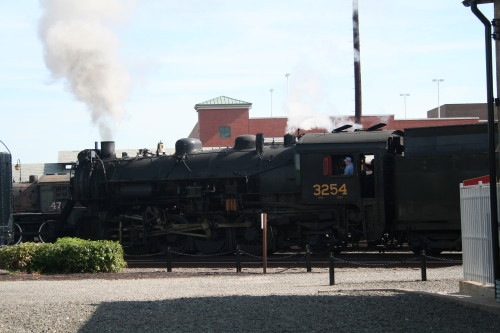
The age of the steam locomotive is past, but this unit of the National Park Service is dedicated to educating the visitor of the importance of the railroad system in American history. In an effort to accomplish this goal, or perhaps in conjunction with it, the park service has older railroad men teaching younger railroad enthusiasts the skills of trade in the railroad business. At Steamtown they not only restore steam locomotives and passenger cars to their bygone glory, but they also keep them operational. Steamtown is not a replica of a rail yard—it is the Scranton rail yard of the Delaware, Lackawanna and Western Railroad (DL & W), the work horses during the early 1900s.
The Round house
The Museum building

Although no engine was on the turntable when we were there, it is a working replica, used to turn engines around before they were capable of running in both directions. The roundhouse has been restored with 2 original sections built in 1902 and 1937 and contains several locomotives for close-up inspection. This was the place where safety inspections were done. A steam locomotive had to be inspected every 30 days. Having sat in the engineer’s seat with my leg against the fire box wall, that didn’t seem excessive to me. We also got a guided tour of the maintenance shop where engines were being repaired and restored.
The turntable
The largest engine we saw
A steam engine enthusiast trying to teach us.
A passenger car used for excursions.
What's this doing to our air we breathe?

The railroad was an important factor in the history of our country, moving goods across the land at a high rate of speed. The railroads led to the availability of fresh produce year round, the cattle drives to meat packing plants in Chicago, and the transport of coal to fuel the Industrial Revolution. It was great to see this American icon up close and personal.